
What Is Machine Learning? A Beginner’s Guide
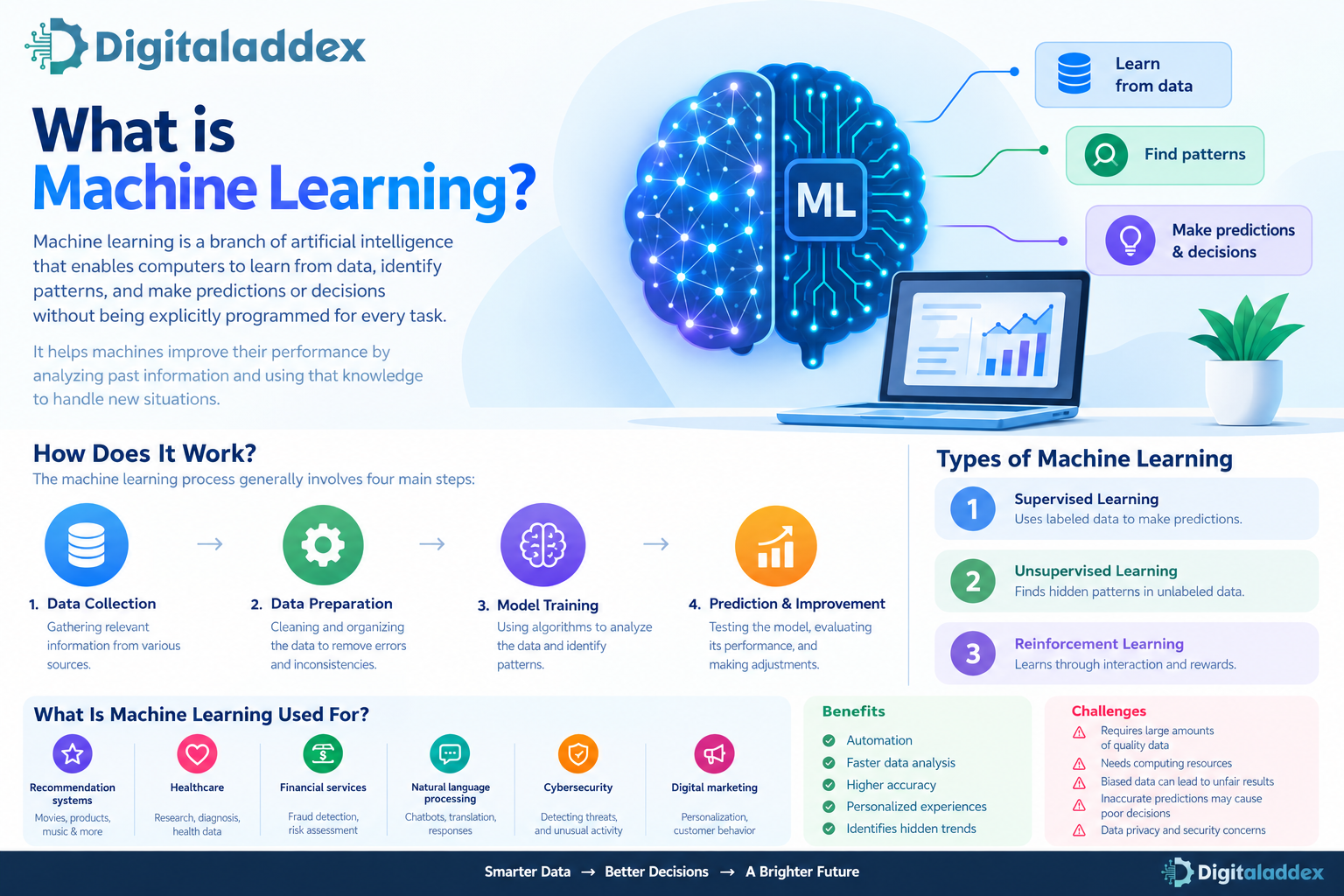
Machine learning (ML) is a branch of artificial intelligence (AI) that enables computers to learn from data, identify patterns, and make predictions or decisions without being explicitly programmed for every task. It helps machines improve their performance by analyzing past information and using that knowledge to handle new situations. Today, machine learning is widely used in healthcare, finance, education, e-commerce, digital marketing, and many other industries.
How Does Machine Learning Work?
Machine learning works by training computer systems on datasets. These datasets contain information that helps algorithms recognize patterns and relationships. Once trained, the model can use those patterns to make predictions or classify new information.
The machine learning process generally involves four main steps:
-
Data Collection: Gathering relevant information from databases, websites, applications, sensors, or other sources.
-
Data Preparation: Cleaning and organizing the data to remove errors, inconsistencies, and unnecessary information.
-
Model Training: Using machine learning algorithms to analyze the data and identify patterns.
-
Prediction and Improvement: Testing the model, evaluating its performance, and improving it with additional data or adjustments.
For example, an email service can learn from previously identified spam messages to recognize suspicious emails and automatically move them into a spam folder.
Types of Machine Learning
There are three major types of machine learning, each designed for different tasks and learning approaches.
1. Supervised Learning
Supervised learning uses labeled data, meaning the training examples include the correct answers. The algorithm learns the relationship between inputs and outputs to make predictions about new information.
For example, a supervised learning model can analyze historical house prices, locations, and property sizes to estimate the price of a new property. Other applications include fraud detection, email classification, and sales forecasting.
2. Unsupervised Learning
Unsupervised learning works with unlabeled data. Instead of receiving predefined answers, the algorithm identifies hidden patterns, similarities, or groups within the information.
Businesses often use this approach for customer segmentation, product recommendations, and discovering purchasing behavior. For instance, an online store can group customers according to their browsing habits and buying preferences.
3. Reinforcement Learning
Reinforcement learning enables an agent to learn through interactions with an environment. It receives rewards or penalties based on its actions and gradually develops strategies to achieve specific goals.
This approach is used in robotics, game-playing systems, and certain autonomous decision-making applications.
What Is Machine Learning Used For?
Machine learning has many practical applications in everyday life and business operations, including:
-
Recommendation systems: Suggesting movies, products, music, and videos based on user preferences.
-
Healthcare: Supporting medical research, analyzing health data, and assisting disease detection.
-
Financial services: Identifying suspicious transactions and assessing financial risks.
-
Natural language processing: Helping chatbots understand questions, translate languages, and generate responses.
-
Cybersecurity: Detecting unusual activities and potential security threats.
-
Digital marketing: Predicting customer behavior, personalizing campaigns, and analyzing advertising performance.
These applications help organizations process large amounts of information and make more informed decisions.
Benefits and Challenges of Machine Learning
Machine learning offers several benefits, including automation, faster data analysis, improved prediction accuracy, and personalized user experiences. It can also help businesses identify trends that may be difficult to recognize through manual analysis.
However, machine learning has limitations. Models often require large amounts of quality data, computing resources, and ongoing monitoring. Biased training data can produce unfair results, while inaccurate predictions may lead to poor decisions. Data privacy and security must also be considered when developing machine learning systems.
Conclusion
Machine learning is an important technology that allows computers to learn from data and improve their ability to perform specific tasks. From personalized recommendations to fraud detection and predictive analytics, its applications continue to expand across industries. Understanding how machine learning works, its main types, and its real-world uses can help individuals and businesses recognize opportunities to use AI effectively. As technology advances, machine learning will remain an essential part of modern digital innovation.

 Arabic
 French
 Spanish
 Portuguese
 Deutsch
 Turkish
 Dutch
Dutch
 Italiano
 Russian
 Romaian
 Portuguese (Brazil)
 Greek
Greek