
KP AUTOMATIONS Industrial Pasta Making Machine: Planning Capacity for Growing Production Demand
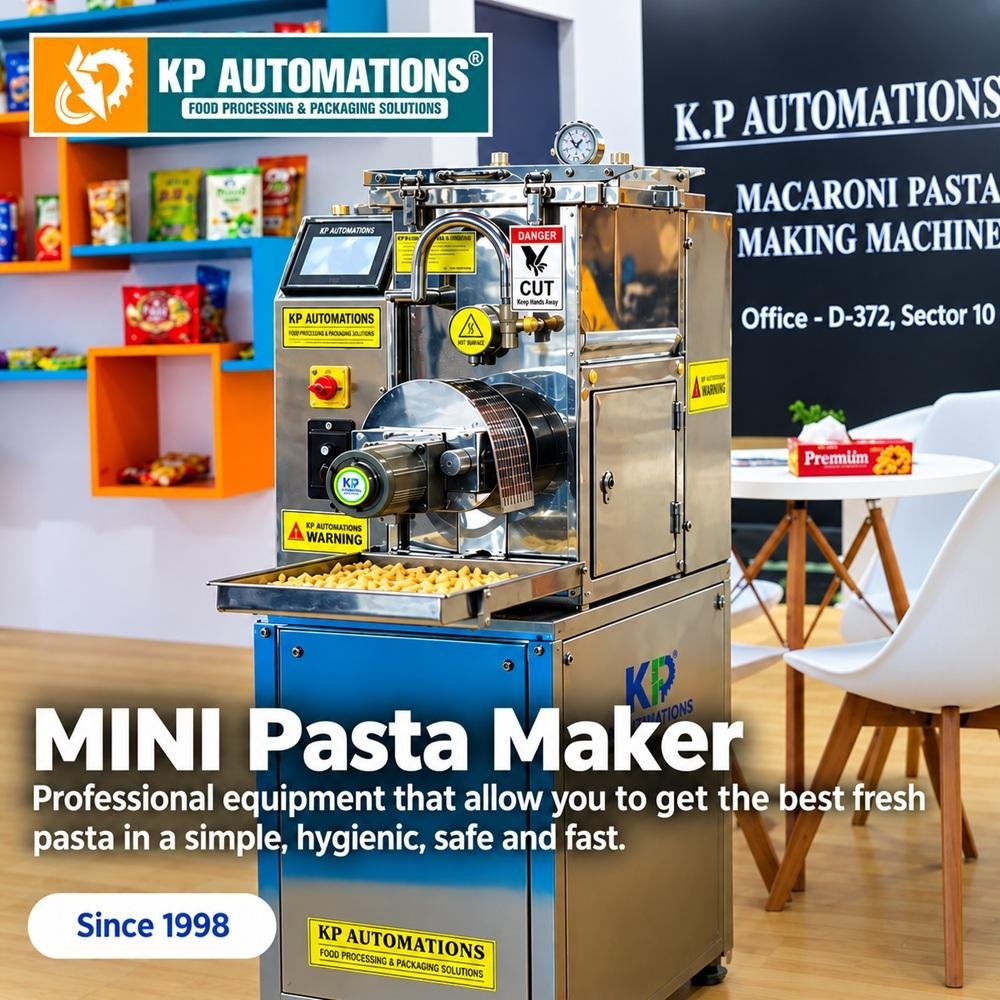
As a pasta manufacturing business grows, its equipment must support more than today's production targets. New customer orders, additional product varieties, larger distribution networks and changing pack sizes can all increase pressure on the factory. Choosing an industrial pasta making machine therefore requires careful planning around current output, expected demand and the capacity of every connected production stage.
A machine with a high advertised output may not deliver the expected finished-product volume if drying, cooling or packaging becomes a bottleneck. For this reason, manufacturers should assess the entire production workflow before investing in new equipment.
KP AUTOMATIONS provides pasta processing, drying, packaging and automation solutions for commercial and industrial manufacturers. A coordinated equipment strategy can help businesses plan a production setup that meets operational requirements today while leaving a practical path for expansion.
Why Production Capacity Should Be Planned as a Complete System
Production capacity is often expressed as kilograms per hour, but the number alone does not explain how much finished pasta a factory can consistently produce.
The result depends on several connected factors, including raw-material preparation, extrusion performance, pasta shape, drying time, product handling, packaging speed and scheduled operating hours.
A typical production workflow includes:
-
Raw-material preparation and mixing
-
Dough extrusion and pasta shaping
-
Cutting or product separation
-
Controlled drying
-
Cooling and product transfer
-
Weighing and packaging
-
Finished-goods inspection and storage
Each stage needs to support the production plan. If one section consistently operates below the required throughput, it can restrict the output of the whole line.
Before purchasing an automatic pasta making machine, manufacturers should establish the target quantity of saleable, finished pasta rather than focusing exclusively on the output of the extrusion section.
Understanding the Difference Between Machine Output and Finished Output
The theoretical output of a machine is not necessarily equal to the quantity of packaged pasta produced during a shift.
Production interruptions, cleaning, product changeovers, maintenance, drying requirements and packaging adjustments can all influence the final result.
For planning purposes, manufacturers should distinguish between three measures:
Rated capacity: The output stated for a machine under specified operating conditions.
Practical production capacity: The output that the equipment can sustain under the factory's actual operating conditions.
Finished-pack output: The quantity of saleable product that completes processing, drying, cooling, inspection and packaging.
These measures answer different questions. Rated capacity helps compare equipment specifications, practical capacity supports operational planning, and finished-pack output connects production performance with sales commitments.
A realistic capacity assessment should account for all three.
Selecting the Right Automatic Pasta Machine for Business Growth
An automatic pasta machine can support a range of commercial requirements, from smaller production operations to large industrial facilities. The appropriate configuration depends on the products being manufactured, the desired output and the expected operating schedule.
Before finalizing a machine, define:
-
Expected daily and monthly demand
-
Target production per hour
-
Number of production shifts
-
Required pasta varieties
-
Frequency of product changeovers
-
Available factory space
-
Drying and packing requirements
-
Expected demand growth
A smaller operation may prioritize manageable operating requirements and flexibility, while a high-volume manufacturer may need a more integrated production line with greater automation.
The objective is not necessarily to buy the largest available machine. It is to select equipment that can meet the business's actual requirements without creating avoidable capital or operating costs.
Planning for Multiple Pasta Varieties
Manufacturers may produce penne, macaroni, fusilli, vermicelli, spaghetti or other pasta varieties. Each product can introduce different requirements for shaping, cutting, drying, conveying and packaging.
An automatic pasta making machine may support several product types when compatible dies and the required accessories are available. However, product flexibility should be confirmed against the exact machine specification.
A useful product-planning exercise identifies:
-
The main products expected to account for most sales.
-
Additional varieties required by customers.
-
The tooling needed for each product.
-
The time and procedures required for changeovers.
-
The drying and packaging arrangements suitable for each variety.
This information helps manufacturers avoid selecting a production system that meets the required output for one product but struggles when the product mix changes.
Why the Automatic Pasta Dryer Must Match Production Capacity
Drying can influence both the flow of product through the factory and the final condition of the pasta.
An automatic pasta dryer removes moisture under controlled conditions according to the product and system design. Depending on the equipment, the process may involve controlled temperature, humidity, airflow and residence time.
The drying capacity must be evaluated alongside the output of the pasta-forming section. If freshly formed pasta enters the drying stage faster than it can be processed, accumulation may occur and disrupt production.
When comparing a pasta dryer, manufacturers should consider more than the stated hourly capacity. Relevant factors include:
-
Pasta type and dimensions
-
Drying method
-
Required moisture reduction
-
Drying-cycle or residence-time requirements
-
Air circulation and temperature control
-
Product loading and transfer
-
Available installation space
-
Maintenance access and utility requirements
The exact drying conditions should be established for the product and validated for the equipment being used.
Batch Drying or Continuous Drying?
The appropriate drying arrangement depends on how the factory plans to operate.
A batch or room-drying system processes defined quantities in a drying space or on racks. This arrangement may suit businesses with batch-based production schedules or specific loading requirements.
A continuous dryer moves product through a sequence of controlled drying zones and may be appropriate for a production line designed to operate continuously.
Neither option is automatically best for every factory. Manufacturers should compare the production schedule, product range, available space, required output and handling arrangements before selecting a system.
For businesses planning higher volumes, it is particularly important to understand how the dryer will receive product from extrusion and deliver dried pasta to the cooling and packaging sections.
Preventing Packaging From Becoming a Bottleneck
The automatic pasta packing machine is another important part of capacity planning. It converts processed pasta into finished packages through operations such as weighing, filling and sealing, depending on the selected configuration.
Packaging throughput can vary with pack weight, product shape, feeding method, film format and weighing cycle. A stated packages-per-minute figure should therefore be assessed against the intended product and package specification.
For example, a line producing large volumes of pasta may require different packaging arrangements for small retail pouches and larger food-service packs.
Before purchasing packaging equipment, determine:
-
Target pack weights
-
Required packages per minute
-
Number of pack formats
-
Pasta shapes to be handled
-
Film and pouch requirements
-
Expected changeover frequency
-
Finished-pack handling arrangements
Matching packaging capacity to the rest of the line helps prevent finished product from accumulating before filling and sealing.
How to Calculate a Practical Production Target
Manufacturers can start with a simple planning calculation:
Required hourly output = Target finished quantity ÷ Planned productive hours
For example, suppose a business wants to produce 4,800 kg of finished pasta during a production day and expects to have 8 productive hours available.
The basic target is:
4,800 kg ÷ 8 hours = 600 kg per productive hour.
This calculation provides a starting point, not a final machine specification. The business must also account for expected downtime, product changeovers, yield, drying requirements and the capacity of downstream equipment.
If 600 kg per hour is the finished-product target, the extrusion section may need to be rated above that figure, depending on the process and actual operating conditions. The appropriate allowance should be determined using supplier data and production trials rather than an arbitrary percentage.
Planning Factory Space and Material Movement
Production capacity is also influenced by the physical arrangement of the facility.
The factory must provide enough room for the machinery, operator access, maintenance activities, raw-material storage, packaging supplies and finished-product handling.
When evaluating an industrial pasta making machine, consider how product will move between each stage. Unnecessary transfers or poorly positioned equipment can complicate operation and make it harder to maintain a steady production flow.
A factory layout should account for:
-
Ingredient receiving and storage
-
Mixing and extrusion equipment
-
Drying and cooling areas
-
Packaging-material storage
-
Finished-product inspection
-
Finished-goods storage
-
Maintenance access
-
Worker movement and safety
-
Electrical and other utility connections
The layout should be reviewed alongside the machine specification so that production capacity is not planned independently of the available infrastructure.
Automation and Operator Requirements
Automation can help coordinate selected machine functions, monitor operating parameters and reduce repetitive manual work. Depending on the configuration, a production line may use PLC controls, sensors, operator interfaces and automated product transfer.
However, automation does not remove the need for trained operators. Staff still need to understand startup procedures, approved recipes, alarms, cleaning requirements, quality checks and safe shutdown practices.
For a growing factory, operator training should be planned before commissioning. Standard operating procedures can also help maintain consistency between shifts and reduce dependence on informal instructions.
When selecting an automatic pasta machine, manufacturers should discuss the level of automation included, which operations require manual intervention and how operators will monitor the production process.
Maintenance Planning for Higher Production Volumes
As production hours increase, maintenance planning becomes more important. A component failure in a critical stage may interrupt the entire production sequence.
Preventive maintenance should follow the equipment manufacturer's instructions and account for the machine's operating conditions. Depending on the design, inspections may cover dies, extrusion components, bearings, belts, sensors, motors, conveyors and packaging mechanisms.
A practical maintenance plan includes:
-
Scheduled inspections
-
Cleaning and lubrication where specified
-
Monitoring of unusual noise or vibration
-
Records of recurring alarms and faults
-
Identification of critical replacement parts
-
Maintenance access and safety procedures
-
Documentation of completed work
Manufacturers should also discuss spare-parts identification and technical support with the supplier before commissioning the equipment.
Planning for Future Expansion
Demand may grow after a factory has been operating for some time. A well-planned initial installation can make later expansion easier, although additional capacity will still require technical assessment.
Depending on the original design, a business may eventually consider adding another production line, increasing drying capacity, expanding packaging capability or introducing additional dies and product formats.
The most useful preparation is to identify likely expansion scenarios early and discuss them during equipment planning.
Questions to consider include:
-
Can the available floor space accommodate future equipment?
-
Will the electrical supply support the planned expansion?
-
Can product handling be extended?
-
Is additional drying capacity likely to be required?
-
Can packaging be expanded without disrupting existing production?
-
Are maintenance access and storage provisions sufficient?
A realistic expansion plan allows the manufacturer to prioritize investments according to demand rather than redesigning the factory after every increase in sales.
Choosing KP AUTOMATIONS for an Integrated Production Setup
KP AUTOMATIONS provides pasta processing, drying, packaging and automation solutions for commercial and industrial manufacturers. For businesses comparing a pasta machine or planning an upgrade, the key is to communicate the complete production requirement.
The project specification should include the target output, pasta varieties, operating schedule, drying approach, package formats, factory layout and future expansion expectations.
With these requirements defined, the proposed machinery can be evaluated as a connected production system rather than as separate purchases.
Manufacturers should confirm the technical specifications, utility needs, installation scope, operator training, maintenance arrangements and component compatibility before placing an order.
Conclusion
Selecting an industrial pasta making machine requires a realistic understanding of production demand and the capacity of the complete factory. Extrusion output is only one part of the equation; drying, cooling, packaging, maintenance and operator readiness also influence the quantity of finished pasta a business can deliver.
An automatic pasta machine should therefore be planned alongside an appropriately specified automatic pasta dryer, pasta dryer and automatic pasta packing machine.
By defining production targets, evaluating the product range and coordinating every processing stage, manufacturers can make more informed equipment decisions and prepare for future growth.
KP AUTOMATIONS offers pasta processing, drying, packaging and automation solutions for businesses seeking a coordinated approach to commercial and industrial pasta manufacturing.

 English
 Arabic
 French
 Spanish
 Portuguese
 Deutsch
 Dutch
Dutch
 Italiano
 Russian
 Romaian
 Portuguese (Brazil)
 Greek
Greek