
Can NFPA Tank Inspections Be Done Without Draining Your Fire Water Tank?
Imagine a plant manager told that her fire water tank needs an internal inspection. Her first thought isn’t about corrosion. It’s about the outage. underwater inspection services Draining a tank means losing fire protection capacity for days, then waiting for a refill. That’s a big operational headache, and plenty of people put the inspection off because of it.
So here’s the natural question: can NFPA tank inspections be done with the water still in? According to Ven-Tech Subsea, potentially yes. This article walks through what the company says, where the limits are and what to confirm before you commit.
The Short Answer
Ven-Tech says internal work may be completed with the tank full or isolated without draining, where the facility, adopted requirements and owner approved plan permit. That can protect fire water availability, reduce refill time and avoid unnecessary outage exposure.
Note the wording: “may” and “where permitted.” This isn’t a blanket promise. Suitability depends on the required scope, tank configuration, water condition, access, system status and an impairment plan accepted by the owner and applicable authority. Drained access may still be needed for specific testing or repairs.
How a Filled Tank Gets Inspected
Commercial Divers
When physical contact matters, commercial divers provide close observation, controlled cleaning and targeted measurements. They can inspect accessible roof, walls, floor and structural components, remove sediment near suction and outlet components and take ultrasonic thickness readings.
ROVs and Robotics
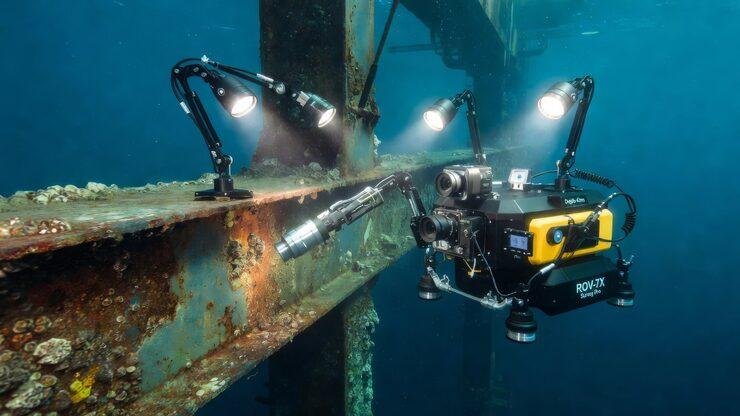
When remote work can answer the question, compact ROVs, magnetic crawlers and robotic vacuum systems keep personnel outside the stored water environment. They offer HD visual inspection, robotic floor cleaning and sonar support for low visibility, and crawler NDT options for suitable steel tanks.
A Combined Method
Complex tanks can use both. Robotics establishes condition and priorities first, then divers go in where direct inspection, measurement, cleaning or intervention adds value. It’s one coordinated evidence package, which reduces exposure while keeping hands on capability.
Protecting the Fire Water Supply
For NFPA tank inspections, the access and impairment plan is project specific. Ven-Tech reviews tank and system status, defines impairment boundaries with the owner and qualified fire protection representatives, plans access and emergency recovery and prepares equipment and staging.
That planning matters because a fire water tank isn’t just a tank. It’s part of a water based fire protection system. Notifications, compensatory measures and restoration responsibilities need clear owners before anyone opens a hatch. Skipping that step is how small projects turn into big problems.
What the Standard Is and Isn’t
The page explains that NFPA 25 is an inspection, testing and maintenance standard for water based fire protection systems, while NFPA 22 addresses tank design, construction and installation. Ven-Tech supplies internal condition evidence and field services within the owner’s broader program.
It also says the 2026 edition is current, but the legally or contractually applicable edition depends on adoption by the jurisdiction, owner requirements, insurer expectations and the authority having jurisdiction. So confirm the controlling edition before setting scope. Don’t assume.
What Gets Inspected
The agreed route can cover accessible roof, walls, floor, columns, braces, ladders, joints, seams, coatings, penetrations, suction piping, outlets, overflows, screens, level components and previous repair locations. Sediment near suction components gets special attention because it can affect usable volume.
Access, visibility, geometry, water movement and obstructions are documented wherever they limit coverage. That honesty is useful. It tells you what was checked, what wasn’t and why, so nobody assumes the whole tank got a clean bill of health when part of it was out of reach.
Planning Your Project
Send the tank location, construction material, dimensions and capacity, hatch details, water level, connected systems, isolation capability, drawings, previous reports, coating history, known sediment, schedule, adopted edition and deliverables. Ven-Tech will review the method with you.
The commercial diving line is 604 230 3022, and the email is info@ven-techsubsea.ca. If you also have a potable reservoir, ask about related services. Combining work across tanks can simplify planning and keep your records consistent.
Conclusion
Draining a fire water tank isn’t always the only path. Where conditions allow, a filled tank inspection can protect availability and cut downtime. The key is planning: confirm the edition, define the impairment boundaries and choose the method around the tank. With those in place, NFPA tank inspections become far less disruptive.
FAQs
Can a fire water tank stay full during inspection?
Potentially, depending on scope, tank configuration, system status, owner approval and authority requirements.
Should I use a diver or an ROV?
ROVs suit remote visual work and cleaning. Divers suit close access, touch and ultrasonic measurements. A combined method is possible.
Which NFPA 25 edition applies?
The 2026 edition is current, but the applicable edition depends on jurisdiction, owner, insurer and authority requirements.
Does the inspection prove NFPA compliance?
No. Ven-Tech supplies internal tank evidence. Overall compliance remains with the owner and qualified fire protection professionals.

 English
 French
 Spanish
 Portuguese
 Deutsch
 Turkish
 Dutch
 Italiano
 Russian
 Romaian
 Portuguese (Brazil)
 Greek